
Geo-distributed Active Archives Based on S3-to-Tape Technology
 Challenges related to storage, data management, and archiving, in particular, remain significant. The unabated growth of data driven by AI applications results in rising storage and energy costs, and the demand for data resilience continues to increase. Geo-distribution is a key strategy for ensuring data protection, creating specific demands for active archiving strategies.
The ability to distribute data across multiple geographic locations is crucial to protecting data against local disasters, such as power outages, floods, and fires. Additionally, this approach complies with recommendations and regulations that mandate geographic separation of data.
Why S3-to-Tape?
The latest advancements in tape system integration offer new possibilities for using tape and for long-term, distributed data management architectures.
Modern S3-to-Tape solutions provide a software layer that seamlessly integrates tape libraries via the standardized S3 API. The software gateway receives data via S3 and writes it directly to tape. Consequently, any S3 application can use the tape library as target storage, regardless of its location. Tape object storage can be seamlessly integrated into cloud workflows, providing remote access for both writing and reading.
S3-to-Tape software solutions enable high performance values through high scalability and simultaneous writing to multiple media.
This new flexibility in the use of tape, coupled with its well-known economic and ecological benefits, paves the way for geo-distributed storage architectures for long-term archiving, keeping cold data sets accessible and secure. This is particularly important when setting up an active archive for data derived from AI applications and other data-intensive workloads.
Key Considerations for a tape-based, geo-distributed active archive
What major challenges must the S3-to-Tape solution handle in order to provide secure and reliable geo-redundancy and compensate for the failure of an entire site?
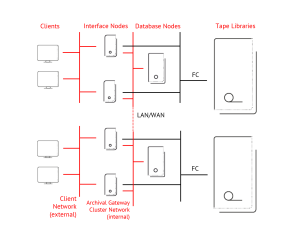
- Scalability and cross-site installation: The solution must be designed for flexible scalability and cross-site installation. This is important not only in view of growing data volumes. It is also essential that scaling be organized so that the solution can be installed at multiple locations, e.g., via a node-based architecture.
- Support WAN latency: In order to prevent data loss in case of site failure, the software must be able to handle WAN latencies between the different sites to ensure seamless replication processes.
- Synchronization and erasure coding across sites: Depending on the requirements of the individual use case, redundancy can be ensured by automatic synchronization and cross-site erasure coding.
- Automatic Site Failover: In the event of a failure, automatic site failover must ensure uninterrupted operation.
Automatic resynchronization after site failover: The subsequent automatic resynchronization after fixing the failure ensures that all locations are back up to date as quickly as possible.
Conclusion
S3-to-Tape systems are set to become a central component of modern, distributed data architectures. They are essential for active archiving because they offload cold data to tape while maintaining its accessibility. These systems are a key infrastructure element that balances performance, resilience, and sustainability.


